Why Almeria, and why now
Almeria, in the province of El Ejido in Andalusia, is what specialists call "the sea of plastic" — the world's largest concentration of market garden greenhouses, visible from space. This is not a metaphor: it is an integrated industrial ecosystem producing tomatoes, peppers, zucchini, eggplants, melons, and cucumbers at yields that challenge anything still practiced in West Africa.
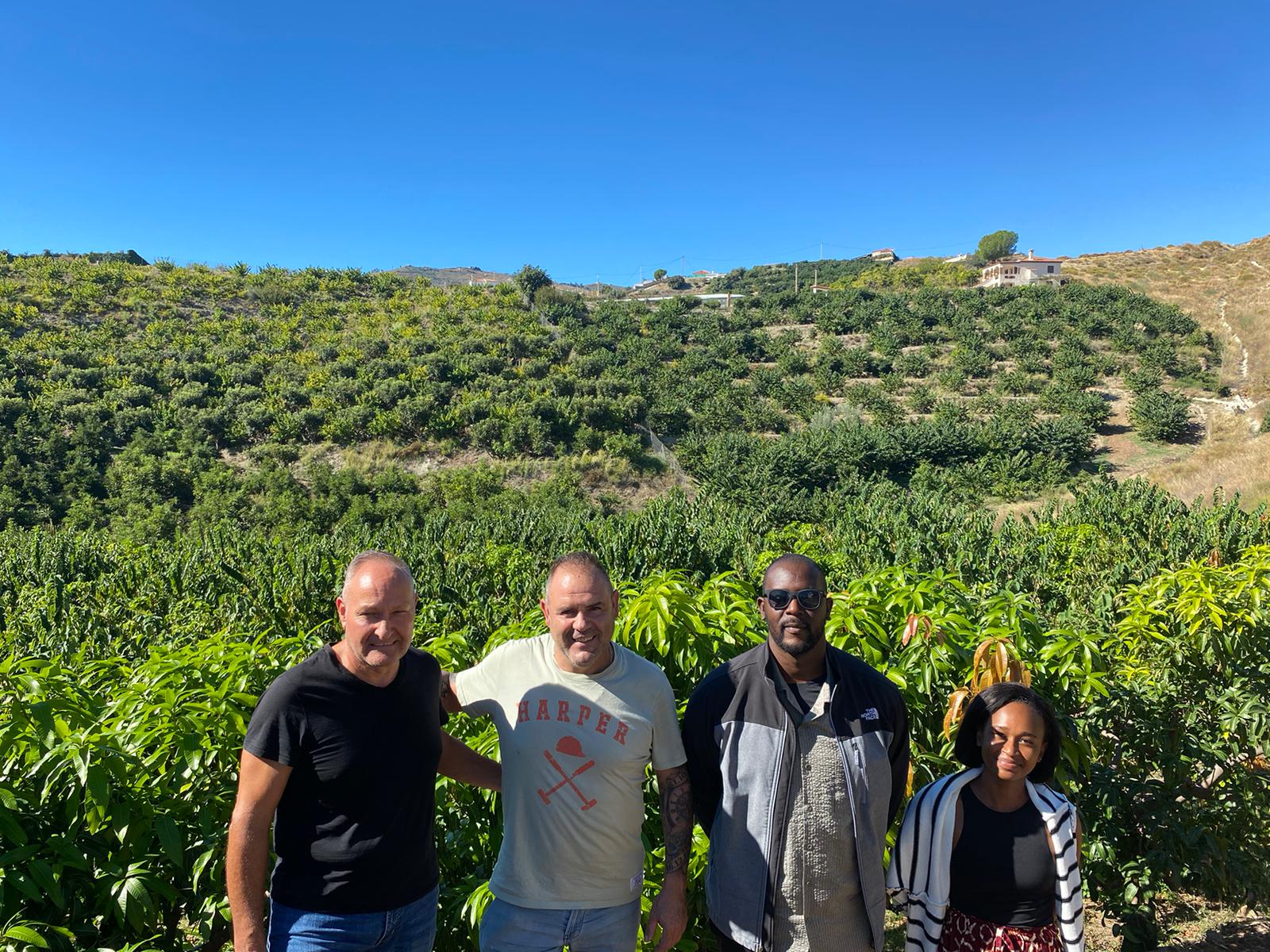
On invitation from our strategic partner Hortalan S.L., a long-established agricultural inputs solutions provider in Spain, we undertook a technical prospecting mission to Almeria and El Ejido. The objective was simple, but the potential is immense: identify the technologies, protocols, and partners capable of being adapted to the Ivorian tropical climate, and build the bridge that, to this day, nobody has truly built here.
This mission is part of the preparation for the Arbre Bio Africa × Hortalan cooperation in Côte d'Ivoire.
What we saw on the ground — and why it changes everything
A greenhouse is no longer a shelter. It is a computer.
The modern Spanish greenhouse is a real-time controlled environment: temperature, humidity, and CO₂ sensors, substrate electrical conductivity probes, automated systems that adjust irrigation and fertigation by the minute. The grower no longer farms by eye — they manage a dashboard.
Coco fiber has replaced soil
A large share of greenhouse cultivation in Almeria is soilless, on coco fiber substrate (coco peat). This is precisely the product that Arbre Bio Africa already distributes in Côte d'Ivoire. Optimal water retention, perfect root aeration, absence of soil-borne pathogens, and full compatibility with fertigation systems.
This is the key element: Côte d'Ivoire, through Arbre Bio, already has access to this resource locally or regionally sourced. We do not need to import the growing medium. We have it.
Water has become a quantified data point
With the precision irrigation solutions of AZUD — a global leader in filtration and micro-irrigation — every drop of water delivered to the plant is measured, dosed, and recycled. This discipline, born from Andalusian water scarcity, will deliver a decisive competitive advantage in Côte d'Ivoire, where agronomic management is still the missing piece.
Inputs are no longer generic "fertilizers"
Almeria growers use gram-precise nutrition programs with specialized solutions such as those from Econatur — biostimulants, targeted foliar nutrition, natural correctors. Inputs that enhance soil health and the organoleptic quality of the final product. This is exactly Arbre Bio's philosophy: produce healthy, natural, and high-value — not simply produce more.
Greenhouses are designed for climate — and here, the tropics demand adaptation
The structures we studied at Novagric are engineered for specific microclimates: natural ventilation, thermal screens, fogging systems, evaporative cooling. The tropical challenge — heat, humidity, high pest pressure, rainy seasons — demands a different design from the Mediterranean model. Adapting, not copying, is the entire challenge.
The Spanish cooperative model is what changes the scale
We studied the operations of cooperatives such as Unica Group — integrated industrial platforms that pool quality grading, logistics, sales, financing, and R&D. An isolated grower remains an isolated grower. A grower within a well-structured cooperative becomes a player in an export-capable value chain. This is precisely what the majority of Ivorian market garden cooperatives still lack.
An honest diagnosis of market gardening in Côte d'Ivoire
Let us be direct, because no progress is built on illusions.
This diagnosis is not a criticism — it is the photograph of the starting point of an opportunity. Every one of these problems has a concrete, deployable, and economically viable solution available today.
The Arbre Bio Africa plan: transfer, adapt, structure
Our Almeria mission was not a study trip. Every visit, every meeting, every protocol observed feeds into a structured plan we are deploying in Côte d'Ivoire along three axes.
Axis 1 — Technology transfer adapted to the tropics
Working with Hortalan, AZUD, Econatur, and Novagric, we are adapting Mediterranean solutions to Ivorian constraints: tropically ventilated greenhouses, local coco fiber substrate, fertigation programs calibrated for tropical varieties, integrated pest management protocols that favor biological control.
Axis 2 — Differentiated production plans by profile
We do not believe in a one-size-fits-all solution. Here is the concrete plan for each group.
The barrier is not willingness — it is the technological entry cost and the absence of agronomic support after installation.
A turnkey greenhouse module of 500 to 2,000 m² with coco substrate, drip irrigation, and full agronomic support from the first to the tenth harvest. Targeted ROI within 24 to 36 months. Structured financing options available.
The barrier is not the number of members — it is the absence of shared infrastructure and a unified quality specification.
An integrated platform model inspired by Unica Group: a shared precision greenhouse hub, a conditioning station, a quality specifications framework, and guaranteed access to inputs and markets for member growers.
The barrier is not demand — it is the impossibility of finding a reliable local supply in sufficient volume, with homogenous quality and full traceability.
Dedicated production contracts under industrial standards: guaranteed volume, homogenous calibration, full traceability, GlobalG.A.P. certification pathway. Exactly what agri-food industry has long sought in Côte d'Ivoire and too rarely found.
The barrier is not the idea or the drive — it is the absence of technical support that transforms capital into a profitable operation rather than an expensive education.
An agronomic incubation pathway: precision technique training, supported installation, access to Hortalan inputs, and field coaching. From concept to first commercial harvest.
The barrier is not capital — it is the absence of structured, bankable agricultural projects with clear governance and auditable financial models.
A pipeline of structured agricultural projects with technical audits, financial models, and governance frameworks — capable of attracting development finance (Proparco, IFC, AfDB, impact funds) rather than relying solely on local financing.
Axis 3 — Valorizing Ivorian natural quality
Côte d'Ivoire must not compete on the terrain of low-end volume — it will not win there. It must compete on the terrain of valorized natural quality: healthy, traceable products with high agronomic value, calibrated for national and regional premium segments. This has been Arbre Bio's strategy from day one, and it is the only approach that creates lasting value.
What this mission changes for the next generation of Ivorian farmers
A hard truth: most young Ivorians no longer see agriculture as a path to the future. This is a collective failure. The reason is not that agriculture is obsolete — it is that the agricultural model being shown to them is obsolete.
A sensor-driven precision greenhouse, an operation that produces year-round, a double-digit net margin, an activity that feeds regional export markets — this is no longer your grandfather's farming. It is a technological, demanding, profitable, and exportable profession. That is the profession the next generation is waiting to be offered.
Arbre Bio Africa's ambition is to become, in Côte d'Ivoire, the actor that makes this profession accessible and desirable.
The partners who make this mission possible
The strength of a project is measured by the quality of its alliances. These are the actors building the next decade of precision agriculture in Côte d'Ivoire alongside us.
Agricultural inputs solutions provider and joint-venture partner in Côte d'Ivoire. Our anchor in Almeria and gateway to Spanish agri-tech.
Global leader in precision filtration and micro-irrigation. Drip solutions engineered for every crop type and soil profile.
Biostimulants and sustainable plant nutrition. Fully aligned with the healthy, natural agriculture that Arbre Bio champions.
Design and installation of high-performance greenhouse structures. Structural expertise for adapting Mediterranean models to tropical climates.
Integrated Spanish cooperative model. Inspires our vision for structuring Ivorian market garden value chains at industrial scale.
Additional institutional and private agreements are currently being finalized. We will communicate as each is signed.
Precision agriculture is not a foreign promise. It is a discipline that can be learned, adapted, and deployed. Côte d'Ivoire has the land, the climate, the people, and — now — the partners. What remains is execution. That is what Arbre Bio Africa does, methodically, from the very first day.
Take action
If you are a grower, agripreneur, cooperative director, industrialist, or investor — here are three immediate steps.
Book a meeting with the Arbre Bio Africa team for an assessment of your project or operation. Every file is reviewed individually.
Follow our upcoming publications — the full lessons from this mission will be developed into dedicated technical articles: substrates, irrigation, structures, fertigation, business models.
Share this article with a player in your value chain who needs to read it. Ivorian market gardening will not transform on its own — it will transform when enough actors decide to change scale.
Be the first to share your thoughts!